What Happens to the Stock Market After a Democratic Sweep in the Midterms?
Every midterm cycle brings the same question: what does the result mean for my portfolio? Well, let’s see what history has to offer us! This time around, Democrats won both the House and the Senate while a Republican sits in the White House. Here’s what has happened in the market when this has happened in the past.
The Data: Seven Midterms Since 1954
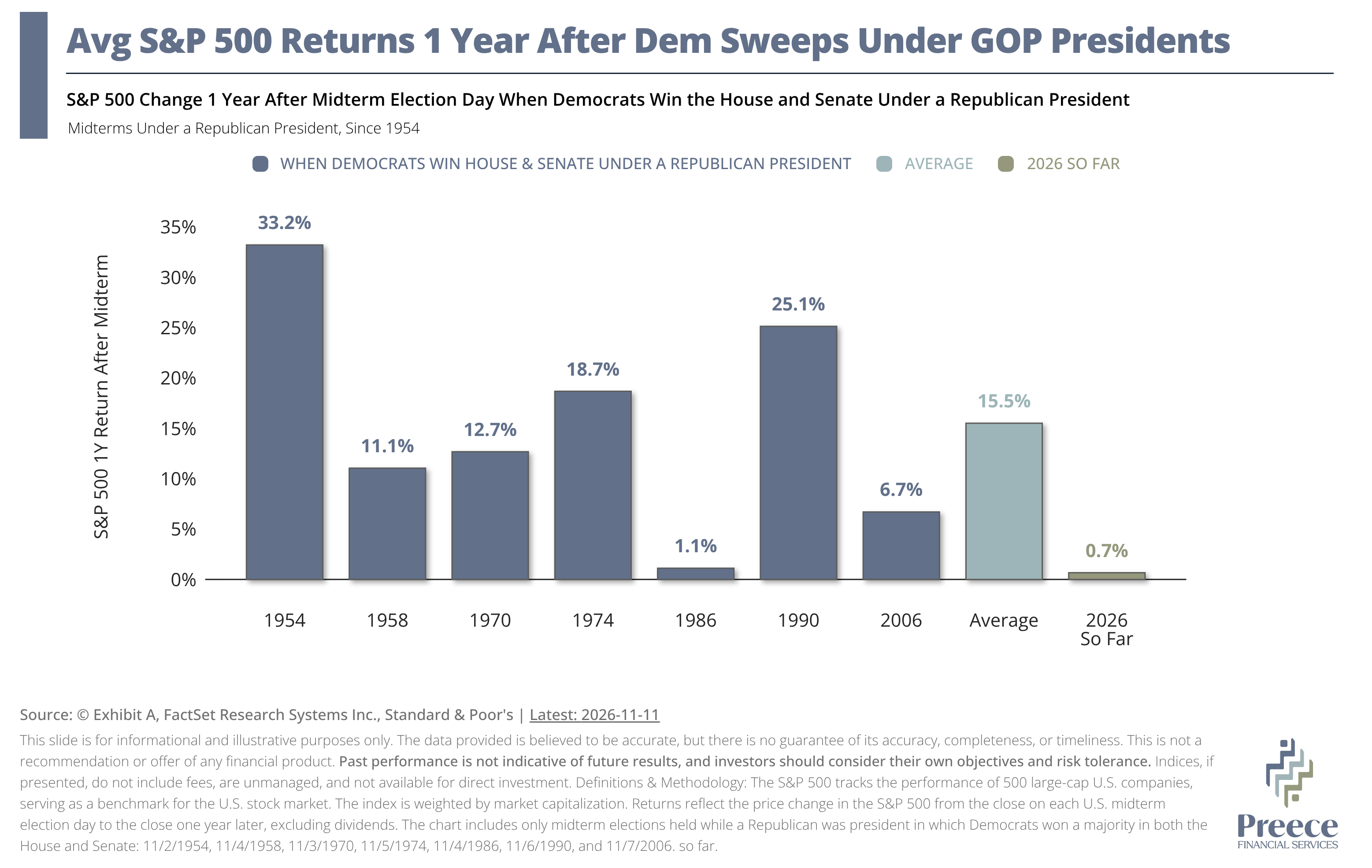
We looked at every midterm election since 1954 where Democrats won a majority in both chambers under a Republican president. We then measured the S&P 500's price change from election day to the close one year later – the S&P 500 is an index that tracks the 500 largest stocks in the US. It’s probably not the best comparison to your portfolio, but it gives us an idea of what to expect from stocks.
S&P 500 Change 1 Year After Midterm Election Day
| Midterm | S&P 500 1-Year Return |
|---|---|
| 1954 | 33.2% |
| 1958 | 11.1% |
| 1970 | 12.7% |
| 1974 | 18.7% |
| 1986 | 1.1% |
| 1990 | 25.1% |
| 2006 | 6.7% |
| Average | 15.5% |
| 2026 So Far | 0.7% |
As you can see, the S&P 500 was higher one year later in all seven cases. The average gain was 15.5%, and the range ran from 1.1% to 33.2%.
How 2026 Compares So Far
Since the 2026 midterm election, the S&P 500 has returned 0.7%. Of course, there’s no value in that data – it’s only been a week. One week (however volatile it may have been) is NOT a good indicator of where the market is going.
Why You Shouldn't Read Too Much Into This
- Seven data points is a small sample. Yes, we’re 7 for 7, on this metric, but the S&P 500 is positive over about 75-80% of years anyway. With 7 examples, it’s not exactly surprising that they’re all positive.
- Ranges matter. The 1986 return was only 1.1%, while 1954 was 33.2%. That’s a significant difference. I don’t know about you, but I’m not making any bets with that wide of a range of outcomes.
- Midterm-year timing may play a role. Historically, markets have often been weak ahead of midterms, so are we really just measuring off of a low base? Could be. The uncertainty tends to cause volatility, and then when the uncertainty is over (after the election), we don’t have as much to worry about.
- Other forces matter more. Earnings growth, interest rates, inflation, and the broader economy drive returns far more than which party controls Washington. Each of these midterms also took place in a very different economic environment.
- Other forces matter more. It’s tempting to believe that all that matters is what’s going on in the news, but that’s not the case. Earnings drive stock prices more than anything else in the long run.
What This Means for Investors
Politics can feel like it should drive markets, but the data suggests that is a weak link. A Republican president paired with a Democratic Congress has historically coincided with positive returns after the midterms – but so have all the other combinations after midterms – from all Democrats to all Republicans and everywhere in between.
A better approach is to stay anchored to your long-term plan:
- Don't make portfolio changes based on election outcomes. Stick to the strategy that aligns with your financial plan.
- Stay diversified – if you’re relying only on stocks (and how they may be impacted by politics), you probably need to review your strategy.
- Revisit your plan if your goals, taxes, or time horizon change. Focus on your long-term plan, not short-term news cycles.
Hi, I’m Austin Preece, CFP®, EA. I’m a fee only financial planner and tax advisor with Preece Financial Services. We have locations near Madison and Eau Claire, Wisconsin. Sign up to be notified via email about future blog posts, so you don’t miss any timely, educational posts.
Preece Financial Services is a DBA of Wealth Planning Advisors LLC, which is an RIA registered in Wisconsin, Minnesota, and Arizona. Tax preparation and planning services as well as bookkeeping and payroll services are offered through Preece Accounting Services LLC.

Austin Preece, CFP®, EA
Financial Planner
Austin is a fee-only financial planner and tax advisor based near Madison, Wisconsin, working virtually with clients across the US. He specializes in comprehensive financial planning, investment management, and tax planning strategies. Haven't found the answers you were looking for in the blog? Reach out!