Why Diversification Matters: Nvidia vs. the S&P 500
It’s easy to look at anything with long-term success, and assume that it was predictable and went up the whole way. But how much risk was involved in getting to where it is today?
Over the last few years, Nvidia has been one of the most successful stocks we’ve seen. It has had incredible growth, but that doesn’t mean investors had an easy time getting there.
Let’s compare Nvidia to the S&P 500.
How Big Can the Drops Get?
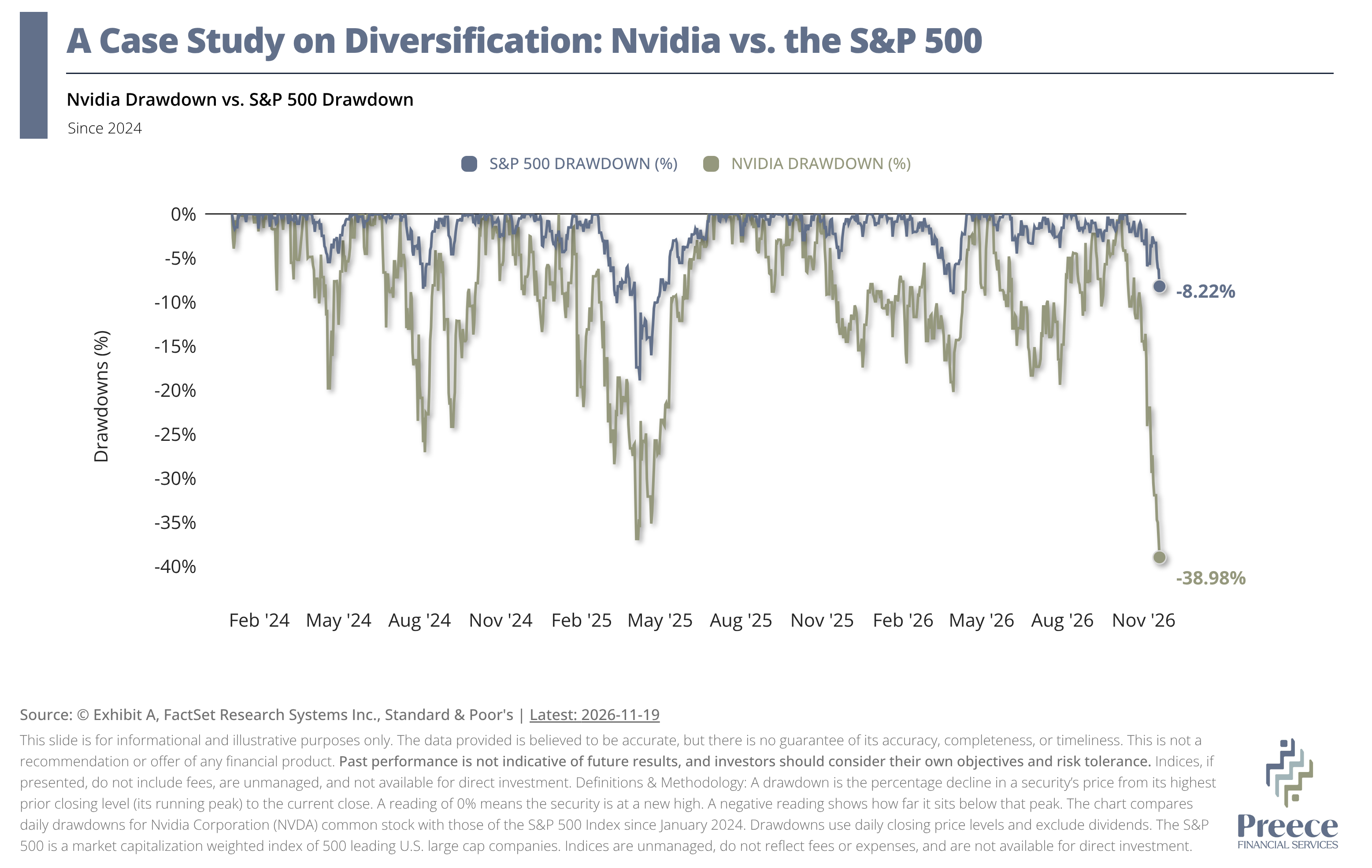
The chart above shows the daily drawdowns of Nvidia and the S&P 500 from their previous peaks since January 2024.
A drawdown measures how far an investment has fallen from its previous peak. Say a stock currently sits at a price of $100, and then drops to $80. That stock has seen a drawdown of 20%.
As of November 19, 2026, the S&P 500 is down 8.22% from its previous peak, while Nvidia is down 38.98%.
That’s a pretty meaningful difference. While the S&P 500 has seen drawdowns during this period, Nvidia’s drawdowns have been much larger. It’s not just one big drawdown either. The chart shows multiple instances where Nvidia fell much further than the S&P.
If you only looked at this chart, you’d wonder why anyone would consider investing in Nvidia. What this chart doesn’t show is how well Nvidia has actually performed during this period. Despite the massive drops, it has still been one of the biggest success stories in the stock market. That’s what makes individual stock picking interesting. There can be the potential for huge returns, but that doesn’t come without significant volatility and risk of loss.
What Does This Actually Tell Us?
There are a few things to note before drawing too many conclusions.
First, this data only goes back to January 2024. This chart could look wildly different if we moved around the starting and ending points.
Also, let's not forget that the S&P 500 has had its share of bad years too. The big difference is that the S&P 500 is diversified among hundreds of different companies, rather than relying on just one to carry the weight of the portfolio.
You don’t need every company in your portfolio to be successful. The idea is to spread your investments around so that the struggles of one company or sector don’t derail your overall plan.
Could Nvidia continue to outperform the market even with its drawdowns? Absolutely. Will it? No one can know for sure.
It’s important to understand the risk you’re taking when chasing the potential high returns of one company.
So, How Should You Think About Your Portfolio?
The point isn’t that you should avoid investing in individual stocks altogether. There’s nothing inherently wrong with putting some money into a stock that you believe in. The question is how much of your portfolio are you willing to put behind that belief?
A few things to keep in mind:
- Concentration: A stock can perform incredibly well and still experience significant drops. If one company makes up too much of your portfolio, those drops can have a major impact on your overall investments.
- Consider the downside: It’s not just about what the investment could gain. Think about how you would react if the investment lost 30%, 40%, or maybe even more of its value.
- Diversification: You don't have to avoid individual stocks to have a diversified portfolio. The goal is to make sure your financial future doesn't depend too heavily on the performance of one company.
At the end of the day, investing isn’t about finding the next big stock. It's about building a portfolio that helps you reach your long-term goals without taking on more risk than you need to.
Hi, I’m Joe Hoffart. I’m a paraplanner with Preece Financial Services. We have locations near Madison and Eau Claire, Wisconsin. Sign up to be notified via email about future blog posts, so you don’t miss any timely, educational posts.
Preece Financial Services is a DBA of Wealth Planning Advisors LLC, which is an RIA registered in Wisconsin, Minnesota, and Arizona. Tax preparation and planning services as well as bookkeeping and payroll services are offered through Preece Accounting Services LLC.

Austin Preece, CFP®, EA
Financial Planner
Austin is a fee-only financial planner and tax advisor based near Madison, Wisconsin, working virtually with clients across the US. He specializes in comprehensive financial planning, investment management, and tax planning strategies. Haven't found the answers you were looking for in the blog? Reach out!